Motivation – Hygiene Theory / Herzberg’s Two - Factor Theory

Hygiene Theory or Herzberg's Two Factor theory of motivation was developed by Fredrick Herzberg on the basis of behavior science. He introduced this theory based on the contents of interviews conducted on 200 engineers and accountants. During the research, good and bad feelings of employees about the job were asked. In conclusion, two factors namely Hygiene and Motivating factors were identified as follows:

1. Hygiene Factors


Hygiene factors are also known as dissatisfaction or maintenance factors on job-context. Presence of these factors do not motivate employees but in the absence of these factors, employees will be dissatisfied or de-motivated. Following factors are included as hygiene factors:
  • Rules and regulations of company
  • Supervision and relationship with supervisors
  • Salary
  • Status
  • Personal life
  • Working condition
  • Relationship with peers
  • Relationship with subordinates
  • Security

Though these factors do not motivate employees but these factors are required to protect them from dissatisfaction. In order to get desired behavior of employees, managers should understand the feelings of employees and try fulfilling them.

Herzberg's Two Factor Theory

2. Motivating Factors


These are the factors which cause the high level of satisfaction and motivation in their presence but do not cause high level of dissatisfaction in their absence. These factors are also called motivators or satisfiers or job content factors. These factors are highly related with job content. Following factors are identified as the motivating factors:
  • Achievement
  • Recognition
  • Advancement
  • Work itself
  • Personal growth
  • Responsibility

In conclusion, Herzberg suggested that to motivate employees, job should be enriched. It can be done through making jobs more challenging, innovating, providing job freedom, opportunity of growth and recognition, guarantee of goal achievement etc. since different people have different level of needs. So, one’s satisfier can be the dissatisfier to other. Therefore, manager should identify the behavior and needs of employees and apply to different factors to satisfy them.

Advantages/ Merits of Hygiene Theory

  • It is a rational approach to motivation. It helps in understanding the effect of job content on motivation of employees.
  • It clearly distinguishes between the factors that motivate employees on the job and the factors that maintain employees on the job.
  • It recommends specific measures (i.e. motivators) to improve motivation levels.
  • It explains the significance of job enrichment on the job redesign and motivation.

Disadvantages/ Demerits of Herzberg's Two - Factory Theory

  • It is difficult to distinguish job-context factors from the job context factors in many cases; job context factors have elements of job context factors.
  • The methodology used by Herzberg is sometimes questioned. Since raters have to make interpretations, different raters may have interpreted the responses in different ways.
  • It explains the reasons of job satisfaction and dissatisfaction. Thus, it is a fact, not a theory of motivation.
  • It ignores the impact of situational variables on motivation.
  • This theory lays much emphasis on motivators and ignores the impact of hygiene factors on motivation.

Maslow’s Hierarchy of Need Theory: Motivation Theory | Assumptions of Maslow's Motivation Theory

Abraham Harold Maslow was born in April 1, 1908 in Brooklyn, New York. He noticed some needs take precedence over others and created a famous hierarchy of needs theory.

As we have already written some ideas about Maslow's Hierarchy of Need Theory in our previous post, here we are writing the more precise ideas of the theory. You can also find some ideas in the following link.


Maslow’s need hierarchy theory is one of the best and well-known theories of motivation. He propounded this theory on the basis of need of the people. He developed the hierarchy of needs model in 1940 – 50s in USA. This theory remains valid today for understanding human motivation, management training, and personal development.

The need that comes first lies at the bottom of the pyramid of need hierarchy. It means, the lower-ordered needs are experienced first. Under this, physiological needs are included like food, cloth, shelter, sex etc.

After satisfaction of the lower needs, people go to the high-order needs which can be explained as follows:

Maslow's Hierarchy of Need Theory

1. Physiological Needs


Physiological needs are first needs that people want to fulfill. It includes food, cloth, shelter, sex etc. These are also known as basic needs. People want to fulfill these needs for the survival and maintenance (continuation) of human life. Therefore, these needs are first satisfied. It lies at the bottom of the need pyramid which means there are large number of people who wants to fulfill the basic needs.

2. Safety Needs


Once the physiological needs are fulfilled, people go for the second needs that is safety or security needs. It includes safety of person, business, job etc. For the safety needs, the insurance benefits highly works. Without satisfying the physiological needs, people cannot imagine to have the safety needs.

3. Social or Affiliation Needs


After fulfilling the security needs, the man enters into the next need that is social needs as a man is a social human being. In this part, he needs to have friendship, belongingness, affection, recognition, etc. from the society. Therefore, an organization must work towards fulfilling the social needs. When they are not socially recognized, the two needs that they have already fulfilled become useless or meaningless.

4. Esteem or Ego Needs


After fulfilling the social needs, people move to the next level of satisfaction that is ego needs in which people get self-satisfied, self-confidence, self-satisfaction etc. In other words, they want high respect from the public. It makes them feel superior in the society due to recognition, appreciation, power and prestige.

5. Self-actualization Needs


It is the final level of satisfaction. According to Maslow, this self-actualization needs lie at the top of the hierarchy. This is the need ‘to be what one is capable of becoming’ and includes needs for optimum development. This implies the desire to become what one can become. In this level, people use their abilities and potentialities fully to realize the need. There are very few people which realize the self-actualization needs.

The first two needs, physiological and safety or security needs are labeled lower-level needs by Maslow. These needs are finite. A man cannot survive without them and a man will be ready to do anything to satisfy these needs. The rest three needs (social, esteem and self actualization needs) are labeled as higher-order needs. In other words, they are secondary needs. They are infinite but they are satisfied only after lower level needs are satisfied. Lower-level needs dominate higher-ordered needs. However, higher-order needs are dominant factors in motivating people at higher level in the management.

Assumptions of Maslow’s Motivation Theory


Maslow’s need hierarchy theory is based on the following propositions or assumptions.

1. Needs can be arranged in an order or a hierarchy. In this hierarchy, physiological needs are at the lowest and most basic. These needs are followed in ascending order by the safety needs, social needs, esteem needs and self-actualization needs.

2. Maslow separated the five needs into higher level needs and lower level needs. According to him physiological and safety needs are lower level or lower ordered needs whereas social, esteem and self-actualization needs are higher level needs. Maslow believed that lower-level needs are mainly satisfied externally whereas the higher level needs are satisfied internally.

3. A man is perpetually wanting animal. As soon as one of his wants or needs is satisfied, another appears in its place. This process goes on in every one’s life.

4. There is always a sequence of emergence of needs. Higher level needs do not emerge or motivate unless all lower level needs have been fairly or minimally satisfied.

5. The first four needs (Physiological, Safety, Social and Esteem Needs) motivate people by their absence. In other words, when people feel a lack of food, clothing, sex, security, social relationships, respect etc, they are motivated to work. But self-actualization needs motivate people by their presence. 

Advantages/ Merits of Maslow's Hierarchy of Need Theory

  • It is based on reasonable assumption and has been substantiated by several research studies.
  • It clearly states that a person advances to the next level of the need hierarchy only when the lower level need is minimally or fairly satisfied.
  • It is a dynamic model because it presents motivation as a constantly changing force. It considers that every individual strives for fulfillment of fresh and higher level needs.
  • It is a positive theory. It assumes that man is a healthy, good and creative being, capable of working out his own destiny.
  • It is logical theory because it recognizes that an individual does something to fulfill his diverse needs.

Disadvantages/ Demerits of Maslow's Hierarchy of Need Theory 

  • Maslow’s theory is based on a small sample of subjects. It is a clinically derived theory which may not be accurate in real life.
  • Human beings are not motivated by their needs alone but also by many other things. Therefore, it is doubtful whether deprivation of a need motivate an individual.
  • There are some who argue that there is no evidence that a satisfied need is not a motivator.
  • It is a simplistic theory and cannot be tested and validated in practice. It lacks empirical testing. It is difficult to interpret and analyze its concepts.

Meaning of Motivation | Types and Processes of Motivation

As we have already written post about the topics on motivation. We are here today to write a post on types of Motivation and the processes of Motivation. If you want to get some concept and different characteristics and importance of Motivation, you can find in the following links:


As Motivation is the psychological process of creating willingness to work and co-operate for the achievement of organizational goal. It is an inner state that energizes, activates and directs behavior towards achieving organizational goals. So, motivation always helps the people to work effectively and efficiently to achieve the goal.

Types of Motivation


There are different types of motivational techniques that are used to motivate employees in the organization. Some of the motivational techniques are listed in following figure:

Types of Motivation

1. Extrinsic Motivation

Extrinsic or external motivation is one which arises from external factors. It is related to job environment. It is the incentive or reward that a person receives after finishing his work. It includes higher wages, profit-sharing, fringe benefits and so on. Intrinsic motivators motivate some people more than extrinsic motivators. But in reality both are necessary. If wages, job security, fringe benefits are inadequate, it would be difficult to recruit and retain good personnel. Turnover, absenteeism and grievances will tend to be higher in the work place when management ignores extrinsic motivation. Therefore, a sound motivation system should provide both extrinsic and intrinsic motivations.

2. Intrinsic Motivation

Intrinsic or internal motivation comes from the satisfaction that arises while performing a job. It is an internal reward i.e. satisfaction which comes while a person is performing his job. Thus, it is a motivation that arises out of a job itself. It is an internal stimulus resulting from job content and not from job environment. Herzberg suggested for job enrichment in order to provide intrinsic motivation. Higher responsibility, opportunity for achievement and individual growth, praise social recognition, etc. are the basic sources of intrinsic motivation.

3. Positive Motivation

Positive motivation is the process of persuading the people to carry out the work by reward. In other words, it is the process of influencing people towards the work. In positive motivation, the people are given different incentives like promotion, reward, increase in payment etc. Positive motivation induces people to do work in the best possible manner and to improve their performance. In most cases, positive motivation greatly works in winning the heart of the employees to make the work done efficiently, significantly and effectively. Under this, better facilities and rewards are provided for their better performance. Such rewards and facilities may be financial and non financial. This approach of motivation is also called ‘Carrot Approach.’

4. Negative Motivation

Negative motivation is the process of forcing people to carry out the work not by reward but by threat or punishment. In negative motivation, different actions are taken against the employees if they don’t work in accordance with direction like disciplinary action, demotion, loss of job, etc. Negative motivation is required when people show negative attitude towards the work and organization. It creates a fear in their mind which will show a positive response towards their duties. Negative motivation aims at controlling the negative efforts of the work and seeks to create a sense of fear for the workers, which he has to suffer for lack of good performance. It is based on the concept that if a worker fails in achieving the desired results, he should be punished. This approach of motivation is also called ‘Hot Stove Approach’.

In fact, both positive and negative motivations are essential in an organization. But, the fact that the work done by heart is more fruitful than the work done forcefully. When a person feels himself to perform in a better way then, it creates enthusiasm and the result is more effective in comparison to the negatively motivated employees. However, both are required in accordance with the need of the organization.

5. Financial Motivation

Financial motivation is the pecuniary motivation and occurs from direct or indirect monetary benefits. Pay and allowance, incentive pay, gain sharing, profit-sharing plans, pension plans, health insurance plans, stock options etc. are the direct financial benefits.

6. Non-financial Motivation

It is one which is not associated with monetary rewards. In fact, non-financial motivation is psychic in nature. It comes from the satisfaction of higher-level needs i.e. social, esteem and self-actualization needs. Work environment, praise, recognition, promotions, more authority and responsibility etc. are the non-financial motivators.

Process of Motivation


The motivational process is the steps that people take to get motivated for the incredible results. If people are properly motivated, they can do the things amazingly. Like any other process, it takes a little work and foresight and planning. The motivational process determines what we want to be motivated to do or to accomplish. This is a specific goal in a very specific area of your life. The motivational process is not best for general motivation, but works best when we need to get motivated to do a specific task, or reach a specific goal. Similarly, it makes up the steps to get the determined goals, little by little.

1. Unsatisfied Needs and Motives

The motivation process starts from the unsatisfied needs. Human is motivated to satisfy needs. Unsatisfied needs cause tension within an individual. Therefore, to release from tension, one has to fulfill unsatisfied needs. Until and unless needs are satisfied, no work can be done satisfactorily.

2. Tension

The tension can be physical and psychological. An individual is not motivated until tension exist in his/her mind. Once need is created, it brings remarkable changes in the behavior of employee to accomplish the job.

3. Action

An individual engages in an action to satisfy needs and motives so as to reduce the level of stress. The best alternative is selected from among many alternatives which help to satisfy needs and motive.

4. Goal Achievement

Goals can be achieved through proper use or reward or punishment. Only motivated employees can help to achieve organizational goal in an anticipated manners.

5. Feedback

Feedback is the response regarding the outcome of motivation. The outcome can be positive or negative indicating how well the goal is accomplished. Once existing needs and motives are satisfied, it ultimately creates new unsatisfied needs and motives. Thus, it is an ongoing process.

Meaning of Motivation | Characteristics and Importance of Motivation

Motivation is derived from the Latin word movere, which means "to move". It is derived from the word "motive". Motive is the inner state of our mind that activates and directs our behavior or implies action to satisfy a need. It makes us move to act. It is always internal to us and is externalized via behavior. Motivation is one's willingness to exert efforts towards the accomplishment of his/ her goal.

Related Topic:
Motivation: Definition and Concept of Motivation


Motivation is the psychological process of creating willingness to work and cooperate for the achievement of organizational goal. Hence, motivation is an inner state that energizes, activates and directs behavior towards achieving organizational goals. So, motivation always helps the people to work effectively and efficiently to achieve the goal. A man can be physically, mentally and technically fit to work but he may not be willing to work. At such situation, motivating an employee is to create a need and a desire on the part of an employee to make him better present performance. Thus, performance is determined by two factors: level of a ability or capability to do certain work and level of motivation. It can be expressed as follows:

Performance = Ability x Motivation

Characteristics of Motivation


Motivation is a theoretical construct used to explain behavior. It represents the reasons for people’s actions, desires, and needs. Motivation can also be defined as one’s direction to behavior or what causes a person to want to repeat a behavior and vice versa. Motivation has following special characteristics.

Characteristics of Motivation

1. Continuous Process

Motivation is a continuous or never ending process. It is so because human needs, desires, wants or wishes are endless. All of them can never be satisfied simultaneously. Satisfaction of one need, gives size to another need. Therefore, motivation process goes on forever.

2. System-oriented

Motivation is system-oriented. It is the system that contains three main factors:
  • Factors operating within an individual i.e. his needs, aspirations, wants, wishes, values etc.
  • Factors operating within the organization such as organization structure, technology, physical facilities, work environment etc.
  • Factors operating in external environment such as custom, norms of society, culture etc. Motivation is the result of interaction among these factors.

3. Need-satisfying Process

Motivation is a need satisfying process. An unsatisfied need creates tension that stimulates drives within an individual. These drives generate a search behavior to find particular goals that will satisfy the need and reduce tension.

4. Dynamic Process

Motivation is a dynamic and complex process. It is so because it is related to human behavior which is never static but dynamic. It keeps on changing continuously.

5. Motivation is Internal Feeling

Motivation is internal feeling of an individual. It points out the energizing forces within an individual that direct or influence him to behave in a particular way.

6. A Psychological Concept

The concept of motivation is mainly psychological. It relates to those forces operating within the individual employee which impels him to act or not to act in certain ways.

7. Energizing Force

Motivation is the process that energizes or encourages individuals to put in effort to achieve organizational goals and to satisfy their needs.

8. Willingness to Exert Effort

Motivation is the willingness of an individual to exert effort in the pursuit of organizational goals and to satisfy some individual needs.

Importance of Motivation


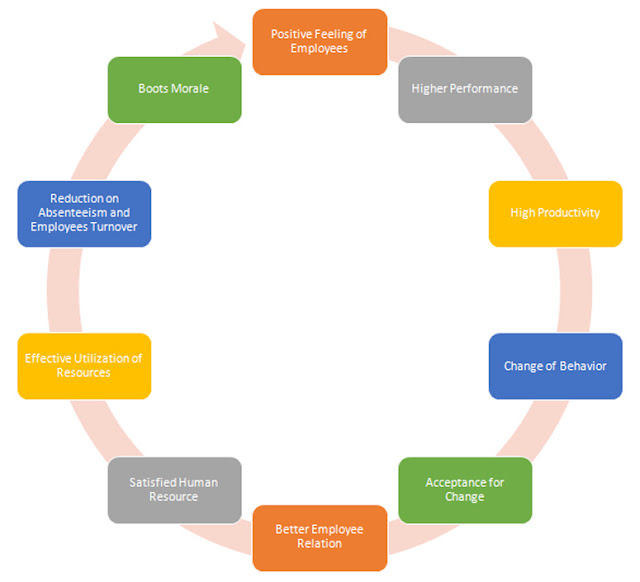
Motivation is regarded as one of the most important functions of management. Importance of motivation can be hardly being overemphasized. Highly motivated people can make things happen in organization. The importance of motivation is summarized in the following points.
Importance of Motivation

1. Positive Feeling of Employees

Effective motivation system inspires employees to do work or to take action. It prepares them to do their work with full devotion. It creates willingness among the employee to perform their work with great enthusiasm, zeal and loyalty.

2. Higher Performance

Highly motivated employees perform better and higher as compared to the employees with low level of motivation. Motivation is the mainspring of performance. Without motivation, the other contributors to performance become rather irrelevant.

3. High Productivity

Motivation increases the productivity of the employees. It utilizes the ability, potentiality, efficiency etc. of the employees. Once the employees are motivated, they do the work heartedly. And this ultimately increases the productivity of the employees and organization.

4. Change of Behavior

It is a research based fact that properly motivated employees are more receptive to new things and ready to accept change. This attitude facilitates to introduce change and keep the organization on the path of progress.

5. Acceptance of Change

Change is the most for organizational and personal development. Through motivation, one can bring change in the resistivity to change behavior of the employees. This helps in accepting the organizational change. Therefore, motivation is important to accept the organizational change.

6. Better Employee Relation

A good motivation system creates congenial work environment and job satisfaction. Employees tend to work with cooperative spirit and in a disciplined manner. Management also offers them better wages and incentives. Hence, chances of conflict are greatly reduced. All this leads to better employee relations.

7. Satisfied Human Resource

A sound motivation system ensures proper supply of motivated human resource. Such a system in an organization can also ensure the satisfaction of needs and aspirations of individuals. Thus, it can attract and retain satisfied human resource in the organization.

8. Effective Utilization of Resources

Motivation helps in utilizing the resources. The motivated employees never let the resources go for wastage. They utilize the resources in an optimum way. They always work hard for the betterment of the organizational development and try to give maximum satisfaction from the minimum resources.

9. Reduction on Absenteeism and Employee Turnover

When the employees are motivated, they are much satisfied with the organization. Because of this, there is low absenteeism and turnover. They stay in the organization for the longer time. When organizations do not do any activities for motivation, then there is high turnover and absenteeism. This high absenteeism and turnover create problems which do not help in realizing the goal of an organization.

10. Boosts Morale

Morale refers to the attitude and feelings of employees about their work and work situation. Through motivation, employee attitudes and feelings towards work can be improved. This in turn boosts employee morale.