Showing posts with label Monopoly. Show all posts

Meaning of Contract and Contract Out: A tool of New Public Management (NPM)

Contract refers to an agreement between two parties or more persons to create and define liability. If the contract is broken or not done as per the agreement, treatment is provided by law. Similarly, contract is an agreement between two or more parties to do or not to do something that can be implemented according to the law. 

Contract out is a tool of New Public Management (NPM). It is an important tool to reduce government expenditure and build a smarter government. Service delivery is on the rise, as the government's financial position is not good, the market is faster and simpler than the bureaucracy and it is the most attractive way to provide services and goods to the people. 

The main function of the government is to provide services to the people, not to hire unwanted employees and the contract system has become better as the market or private sector is better and faster than the government. Nepal has also been adopting contracting out system under the cost reduction system. The process is simple and easy. It has become very attractive in recent times as it gives priority to the outside rather than within the organization. 

Scope of Contracting Out
  • Tax and accounting system
  • Supply and purchase
  • Computer programming
  • Training administration
  • Customer service
  • Transportation of goods and services
  • Salary, facilities and compensation plan
  • Salary report
  • Internal security, gardener, courier, sanitation, maintenance etc. 

Benefits of Contract Out
  • Helps to reduce monopolistic power of the government.
  • Cost saving and gain working efficiency.
  • New technology can be introduced and learnt. The client also introduces new technology.
  • It makes easier to sell cheaply due to cash flow.

Challenges of Contracting Out
  • Quality cannot be maintained due to poor quality control. There may be compromise in quality.
  • Long process.
  • Can remove the strategic direction of the organization.
  • Loyalty to the organization decreases.
  • There can be two types of problems when making a monopoly contract. For example, service providers tend to reduce cost by reducing quality and become monopolistic because there is not much choice.
  • They work together, increase the cost by carteling.

Process of Contracting Out
  • The service is to be done by oneself, whether it is done jointly or from outside.
  • Choose the sector to be given.
  • Contract can be given on the based of nature and availability of service.
  • Needs and demand of services are assessed by users.
  • Agree and contract with the service provider.
  • Supply quality and quantity of goods and services according to price.
  • Government should look after Equity and technical parts.
  • There should be virtuous and non-corrupt behavior.

Necessary Content to be included in Contract Document
  • Service should be measured.
  • Specify the value of service.
  • Change in mechanism for high level needs.
  • To see the arrangement of change and mechanism of service.
  • State the mechanism in case of terminating the agreement.
  • Fix the level of results to be served.
  • Must have complete details about the service.
  • There should be flexibility according to the change.
  • Mention who and when according to contract.
  • The amendment aspect of the service standard should also be mentioned.
  • There should be a mechanism to monitor the quality of service.

Contract Management

The concept of contract management was started since 2001 and is still growing in importance. Contract management have been even made for office cleaning, gardener's work, machine maintenance and maintenance work. There is more emphasis on cost cutting than the means of serving the people.


You may also like to read:

Meaning of Antitrust Policy and Approaches to Antitrust Policy

Antitrust policy refers to the actions the government takes to promote competition among firms in the economy. Antitrust policy includes challenging and breaking up existing firms with significant market power, preventing mergers that would increase monopoly power significantly, prohibiting price fixing, and limiting anti-competitive arrangements between firms and their suppliers.

Antitrust policy began in the United States just over 100 years ago in response to a massive wave of mergers and consolidations. Similar merger movements occurred in Europe at about the same time. These mergers were made possible by rapid innovations in transportation, communication and management techniques. Railroads and telegraph lines expanded across the country, allowing large firms to place manufacturing facilities and sales offices in many different population centers.

Trust (monopoly), corporate monopoly organized under the legal device of trusteeship for the purpose of eliminating competition in an area of business and of controlling the market for a product. Specifically, a trust was a particular technique developed in the late 19th century to consolidate firms and acquire control in a variety of industries. The widespread use and abuse of trusts during this period ultimately gave rise to a series of antitrust laws that continue to be in effect.

A trust is a legal arrangement in which the voting stock of different companies is brought together under the direction of a board of trustees, which then issues trust certificates in exchange for all the shares or a controlling number of shares of the individual companies. This arrangement permits the trustees to manage and direct a group of companies in a unified way, in effect, creating a single firm out of competing firms.

i) Antitrust policy, prohibiting anti-competitive conduct and preventing monopolistic structures, is the primary way that public policy limits abuses of market power by large firms. Thus, policy grew out of legislation like the Sherman Act (1890) and the Clayton Act (1994). The primary purpose of anti-trust is:
  • To prohibit anti-competitive activities (which include agreements to fix prices or divide up territories, price discrimination, and tie-in agreement) and,
  • To break up monopoly structures. In today’s legal theory, such structures are those that have excessive market power (a large share of the market) and also engage in anti-competitive acts.

ii) In addition to limiting the behavior of existing firms, anti-trust law prevents mergers that would lessen competition. Today, horizontal mergers (between firms in the same industry) are the main source of concern, while vertical conglomerate mergers tend to be tolerated.

iii) Anti-trust policy has been significantly influenced by economic thinking during the last two decades. As a result, anti-trust policy during the 1980s focused almost exclusively on improving efficiency, while it ignored earlier populist concerns with bigness itself. Moreover, in today’s economy with intense competition from foreign producers and in deregulated industries, many believe that anti-trust policy should concentrate primarily on preventing collusive agreements like price fixing.

There are two approaches of anti-trust policy. They are:

i) Market performance


Market performance refers to the rate of technological change, efficiency and profit of the industry, conduct of individual firms etc. according to the supporters of this approach to observe how far the concerned firms have served the economy while marking judgment on anti-trust cases, the performance of those firms should be reviewed in detail. If they have served the economy well, only due to their having large market share cannot be regarded as having violated anti-trust laws.

This test strongly relies on the technological progressiveness and ‘dynamism’ of the firms. It is difficult to say whether related performance of a particular firm is ‘good’ or ‘bad’ is the main problem of this approach.

ii) Market structure


The other approach to anti-trust policy is market structure. This approach gives emphasis on the market structure of the industry. Market structure means the number and size distribution of the buyers and the sellers in the market, ease of the entry of new firms, and the extent of the product differentiation. According to the supporters of this approach, market structure should be seen for the evidence of the undesirable monopolistic characteristic. It is considered as having ‘market power’. The market power cannot be protected by economies of scale of or any justifications it should be declared illegal. Here market power refers to having monopoly power.

Though this approach is also not far from the defect. The main defect of this approach is that the relationship between the market structure and the market performance may be very weak. It is socially unacceptable, because certain level of concentration is arbitrarily selected. There are two important acts, which are as follows:

Sherman Antitrust Act


Sherman Antitrust Act, basic federal enactment regulating the operations of corporate trusts, passed by the US Congress in July 1890, through the efforts of Senator John Sherman of Ohio. The act declared illegal “every contract, combination in the form of trust or otherwise, or conspiracy, in restraint of trade or commerce among the several States, or with foreign nations.” Criminal penalties were provided for violators of the law, and aggrieved persons were entitled to recover three times the amount of losses suffered as a result of violation. The Sherman Act has been amended and supplemented by several subsequent enactments. Most notable among these enactments was the Clayton Antitrust Act of 1914.

Clayton Antitrust


Clayton Antitrust Act, legislation passed by the United States Congress in 1914 to prohibit certain monopolistic practices that were then common in finance, industry and trade. Sponsored by the Alabama congressman Henry De Lamar Clayton, the Clayton Antitrust Act was adopted as an amendment to the Sherman Antitrust Act designed to deal with new monopolistic practices. The act contained three distinct types of provisions, covering corporate activities, remedies for reform and labor disputes.

The provisions relating to corporate activities declared illegal practices as local price-cutting to freeze out competitors, exclusive selling or leasing and other forms of price discrimination. The law also forbid inter-corporate stock holdings that allow one firm to gain control over another, thereby lessening competition and certain interlocking directorates, in which a few persons control an industry by serving simultaneously as directors of related corporations.

The act permitted individual suits for damages from discrimination or exclusive selling or leasing and made directors or officers of corporations responsible for infractions of the antitrust laws. Appeals were directed to the Federal Trade Commission, which was, in part, created to enforce the antitrust provisions of the act and which was empowered to issue cease-and-desist orders when illegal activities had been proved.

The act also affirmed the right of unions to strike, boycott, and picket. Its provisions dealing specifically with labor matters limited use of the federal injunction in labor disputes; at the same time, unions were explicitly excluded from the restrictions of antitrust laws. Unfavorable court interpretations weakened the act, however, and additional legislation was required fully to carry out its aims.

Recently ambivalence has grown among lawyers, economists, and business executives with respect to the effectiveness of the nation’s antitrust laws. Some of this stems from the belief that the growth of multinational firms and worldwide competition makes concern about concentration in the domestic market less important. Other experts suggest that a vigilant antitrust stance is essential if price fixing and horizontal type mergers that reduce competition in certain industries are to be prevented.

                You may also like to read:                

Free market economy and the shortcomings of the free market economy

Free Market Economy is the economic system in which individuals, rather than government, make the majority of decisions regarding economic activities and transactions. Individuals are free to make economic decisions concerning their employment, how to use or accumulate capital, what expenditures to make, and whether to use their resources now or to save them for later consumption.

The principles underlying free-market economies are based on laissez-faire (non-intervention by government) economics and can be traced to the 18th century British economist Adam Smith. According to Smith, individuals acting in their own economic self-interest will maximize the economic situation of society as a whole, as if guided by an “invisible hand.” In a free market economy, the government’s function is limited to providing what are known as “Public goods” and performing a regulatory role in certain situations.

The following are the shortcomings of the free market economy:
  1. Leads to monopoly: Competition which is regarded as the very basis of capitalism contains within itself. This tendency destroy competition and leads to monopoly. It is the profit motive under capitalism which leads to cut-throat competition and ultimately to the formation of trusts, cartels and combinations. It brings about a reduction in the number of firms actually engaged in production.
  2. Inequalities: The institution of private property creates inequalities of income and wealth under capitalism. The price mechanism through competition brings huge profits to big producers, the landlords, the entrepreneurs and the traders who accumulate vast amount of wealth which the rich roll in wealth and luxury, the poor live in property and squalor.
  3. Consumer’s sovereignty a myth: Consumer’s sovereignty is a myth under capitalism. Consumers have to rely on only those commodities which are manufactured and supplied by the producers in the market. The majority of consumers are not rational buyers and are often ignorant about the utility and quality of the products available at the stores or shops. They are also misled by advertisement and propaganda about the usefulness of the products. Products which are produced by monopoly concerns are often of an inferior quality and are priced highs. There is no consumers’ sovereignty in a seller’s market.
  4. Depression and unemployment: Capitalism is characterized by business fluctuations and unemployment. Excessive competition and unplanned production lead to over production and glut of commodities in the market and ultimately depression and unemployment occur.
  5. Inefficient production: Capitalism facts to produce goods in keeping with society’s requirements. Frivolous luxury goods and obnoxious articles are produced to satisfy the wants of the few rich at the expense of the necessities needed by the poor. Thus, there is social wastage of economy’s resources.
  6. Non-utilization of resources: The price mechanism under capitalism fails to employ the country’s resources fully. Free and unfettered competition, inequalities of income distribution, over production and consequent depression lead to wastage of productive resources. Besides, there is mass unemployment and freedom of occupation is little under capitalism.
  7. Class conflict: A capitalism society is characterized by class conflict. The poor are exploited by the rich. This leads to mutual distrust between the workers and employers and to social unrest.

These are defects of capitalism that have led the free enterprise economy of the west to modify this system by regulating and controlling the institution of private property and freedom of enterprises to serve the best interests of the community at large.

             You may also like to read:            

Role of the government in the market economy

The market economy is also said to be a free-enterprises economy because the government restrictions on production and distribution are the least possible in such an economy. A capitalist economy is also called a free-market economy because supply and demand forces are allowed a free pay in the markets for factors as well as for products. This type of economy is also known as laissez faire economy because the government in this economy is supposed to intervene into the functioning of an economy only where it is must.

The economic problem is solved by the freely functioning price mechanism. The rise and the fall in the prices of products and factors of production in the markets give signals to the producers and consumers who respond to correct the disequilibria wherever they exist. If there is problem of unemployment that would be solve by reducing wage rate. If a particular commodity is in short supply, then its price will rise in induce producers to increase its output. On the other side, a surplus of a commodity will lead to a fall in its price thereby inducing its producers to contract its production. Thus, it was believed for a long time that a freely functioning price mechanism automatically solves the economic problem in the capitalist economy.

The functioning of capitalist economies for the last three hundred years has proved that a capitalist economy is unable to solve all the economic problems automatically. There are some instances of market failure where the price mechanism is unable to take the correct decisions from the society’s viewpoint. These instances of market failure are popularly known as ‘those goods’, ‘external effects’, ‘market imperfections’ and ‘distribution justice’. The government in a capitalist economy has to intervene in the markets to cover these points of market failure. Thus, the role of the government in a modern capitalist economy can be summed up in the following:

1) Supply of public goods


Those goods and services such as roads, telephone, telegraph, defense, police and justice are called public goods and services. This is because these goods and services are supplied and consumed publicly. No private party will be prepared to build and supply these public goods at which people in general need it. In the capitalist economy, the government at reasonable cost provides these public goods.

2) Management of the external effects


The government is required to tax those people who are in their private production or consumption inflict losses on the other people. Factory-owners, whose production spoils the air and water in the locality are taxed heavily. Similarly, those rich people who tend to make a vulgar show of their wealth are taxed and the proceeds of these taxes are given to the poor people. Further, the government builds health resorts and national parks for which the visitors are charged a toll tax. All these examples are those of external effects.

3) Corrective polity for market imperfections


The price mechanism can work properly only when the markets are competitive and work normally. But there are many imperfections in the market, which tend to go against the national interest.

Firstly, some firms try to build a monopoly to influence in the market through cartels and mergers or through secret understanding. In such cases, the government enforces its anti-monopoly laws to protect the consumers against exploitation.

Secondly, sometimes the speculators in the stocks markets or commodity markets tend to create panic in these markets, which disturbs their normal functioning. The government then partially or wholly bans the functions of these speculators to restore normalcy in these markets.

Thirdly, the association and unions in some markets are deliberately encouraged legally, protected to enhance the bargaining power of the working sections so that they are not exploited by their employers.

4) Public policies against unemployment


In a capitalist economy, there are serious problems of booms and depressions, unemployment and wastage of resources. Governments in capitalist countries are committed to following anti-inflation policies. These policies are of public works, fiscal measures and monetary management. Whenever the capitalist economy shows signs of slackness or stringency, the government comes forward to use the appropriate policies.

5) Redistribute policies


Governments in capitalist economies are also committed to the reduction of income inequalities to a socially tolerable level. The rich people are taxed heavily through tax on income, wealth or expenditure with a view to building large funds to be used for the welfare of the weaker sections. These payments to the poor made from funds obtained through taxation of the rich are called compensatory payments.

In short, the role of the government in a capitalist economy is of a regulatory and protective nature. The effort is to give the maximum of economic freedom allowable to producers and consumers.

             You may also like to read:               

Two Part Tariff Pricing | Should a firm set a high entry fee and low usage fee, or vice versa?

Two part tariff refers to the practice of charging two-part prices by the producer and / or supplier of a goods or services. The term ‘tariff’ stands here for pricing. It can be defined as, “A two part tariff is one in which the consumer must pay a lump sum fee for the right to buy a product.” It is clear that under two-tariff price system, consumers pay a one-time access fee (T) for the right to buy a product, and a per-unit price (P) for each unit they consume. So, the total price for a consumer who pays both entry fee and usage fee will be,

R = T + PX

Where, X are units of product or service X consumed / demanded

A two part tariff is a price discrimination technique in which the price of a product or service is composed of two parts – a lump-sum fee as well as a per-unit charge. In general, price discrimination techniques only appear (take place) in partially or fully monopolistic markets. The main objective of using two part tariff by a firm is to capture more consumer.

A two part tariff is a strategy of price discrimination by firm to capture maximum amount of consumer surplus. The problem for the firm is how to set the entry fee (membership fee) versus the usage fee. The amount of entry fee (membership fee) charged by firms will be different depending on whether the demand is identical or different. A rational firm will set the per unit usage fee above or equal to the marginal cost of production, and below or equal to the price that a firm would charge in a perfect monopoly. Under a condition of competition, the per-unit usage price is set below marginal cost. Basically, it is required that the product or service offered by the firm be identical to all consumers so that price charged may not vary due to differences in production costs of the firm.

Assume that the firm has some market power and it is operating under monopoly. Then the question is: should it set a high entry fee and low usage fee, or vice versa? To see how a firm can solve this problem, we need to know the basic principles involved.

In order to maximize total profits, a monopolist has to charge a usage fee (or per unit price) equal to its marginal cost and initial / entry fee (or membership fee) equal to the entire consumer surplus.

Normally, the concept of two part tariff is applicable in monopoly or monopolistic or oligopoly markets. But economists also argue that two part tariffs may also exist in competitive markets when consumers are uncertain about their ultimate demand.

 Some Related Links:       

The Cartel or Collusion Model

The cartel is an explicit agreement between the oligopoly firms. Cartel agreements represent the most complete form of collusion among the oligopolists. Under cartel agreements, firms jointly establish a cartel organization to make price and output decision, to establish production quotas for each firm and to supervise the market activities of the firm in the industry, cartel type collusions are formed with a view;

i) Eliminating uncertainty surrounding the market and 
ii) Restraining competitions and thereby ensuring monopoly gains to the cartel group.


For this, the board of control first calculates the MC and MR for the industry; MC for industry in the summation of MCs of individual firms. On the basis of industry’s MR and MC, the total output for the industry determined. The determination of industry output is shown in figure C and the share of each firm in figures A and B. For the sake of convenience, let us suppose there are only two firms in the industry, firm I and II. Their cost curves are given in figure C. The industry output is determined at OQ and price PQ on the pattern of monopoly firm.

The share of each firm in industry, quantity is determined at the level of their own output which equates their individual MC with the industry’s MC. The industry’s MC, CQ is determined by the intersection of industry’s MC and MR at point C. The market share of each firm can be obtained by drawing a line from point C and parallel to X-axis through MC to MC1 to the Y-axis. The points of intersection C1 and C2 determine the level of output for firm I and II respectively. Thus, the share of each of the two firms I and II, is determined at OQ1 and OQ2 where OQ1 + OQ2 = OQ. The total profit can be completed as (PQ – Firm’s AC) and firms output which is maximum. The total profit may be different, but there will be no motivation to change in price quantity combinations, since their individual profit is maximum.

  Some Related Links:       

Various uses of income and cross elasticity of demand in business decision-making

The use of income elasticity of demand for a firm’s is to determine the growth opportunities of the firm, useful in targeting marketing efforts, success at different stages of business cycles. Following are the theoretical and practical importance:

1. Estimate the effects of changes in economic activity

During the periods of expansion, incomes are rising and firms selling luxury items that the demand for their products will increase at a faster rate than the rate of income growth.

During a recession, demand may decrease rapidly. Knowledge of income elasticity can be useful in targeting marketing efforts. If per capita or household income is found to be an important determinant of the demand for a particular product, this can affect the location and nature of sales outlets. It can also have an impact on advertising and other promotional activities.

2. Uses in capitalist economics

The concept of income elasticity of demand takes an important place among the analytical tools applied for business research. This concept is of income sensitivity of consumption expenditure. Income sensitivity has a co-efficient which measures the percentage increase in rupee expenditure associated with one percent change in disposable income in the same period. The income sensitivity estimates are of great use in business forecasting.

3. Planned developing economies

In the developing countries like Nepal, as levels of living rise, demand for some commodities is expected to go up much faster than the demand for others. In the earlier stages, income elasticity of demand for food tends to be high. As income rises, there is a shortage of food, which not satisfied, leads to inflation. If the planners know income elasticity of demand for goods and services of general use, steps can be taken to balance demand and supply by using appropriate method.

4. Marketing activity and making market strategy

The concept of income elasticity of demand has important role in marketing activities of the firm. People demand goods and services on the basis of their income level. The level of income of the people affects the location and nature of sales. The high-income elasticity of demand indicates the significant promotional efforts in the business.

It is also useful in making marketing strategy. The business firm should concentrate its marketing efforts in media that reaches to the high-income group of the people.

Importance of Cross Elasticity of Demand


The concept of cross-elasticity is useful for the following main purposes:
  1. Useful in inter-commodity relations: It is important for the firm to be awared of how the demand for its products likely to respond to changes in the prices of other goods; this information is necessary for formulating the firm’s own pricing policy and for analyzing the risk associated with various products. This is particularly important for the firms with extensive product lines, where significant substitution or complementary interrelationships exists between the various products. The concept of cross elasticity of demand is very useful in handling the inter-commodity relations.
  2. Classification of markets and market structure: The classification of markets of commodities and services is mainly based on the concept of cross elasticity of demand of one seller in relation to the other. It is used in industrial organization to measure the interrelationships among industries. The cross price elasticity between the firm’s product and products in related industries is large and positive, the firm, even though it may be a monopolist in a narrow sense, will not be able to raise its prices without losing sales to other firms in related industries.
  3. Importance for anti-monopoly legislation: The concept of cross elasticity of demand has been of practical use in sponsoring anti-monopoly legislation. When a particular seller tries to estimate or buy up substitutes of his own product through unfair means, there is a case of monopoly practice against him. But, it is only of drawing a clear-cut line between fair competition and monopoly, however, it is basic concept of doing so.

  SOME RELATED LINKS:   

Reasons behind aiming at reasonable profit rather than maximum profit by most of firms

In economic theories, it is assumed that maximizing profits is the basic objective of every firm. The volume of profit is regarded as the primary measure of the success of a business. But in recent days, it has been realized that many firms, particularly big one do not operate on the principle of profit maximization in terms of marginal costs and revenues. Instead, the firms set standards or targets of reasonable profits.

This is because of so many reasons. The firms may limit profit or aim at only reasonable profits due to following reasons:
  1. Discourage potential competitors: When a firm earns large profit under profit maximizing objective. It is likely to attract potential competitors to enter the field and capture the market share enjoyed by it. They adopt the practices such as infringement of patent rights, copying of product designs, encroachment upon the firm’s sources of raw materials, etc. To discourage such tendency, a firm may adopt the policy of limiting profits rather than maximization. The danger of potential competition is more serious when the firm enjoys a weak monopoly situation. However, there is no guarantee that limiting profits may prevent potential competition.
  2. Project a favorable image to the public and government: The earning of high profits shows the enjoying of monopoly power. It may create an impression that the firm is exploiting the consumers. Hence, the public may appeal the government for nationalization of the firm or to exercise some sort of regulation of prices, profits and dividends. Therefore, the firms may aim at only reasonable profit. Restraining demand for wage hike. When there is high profit the labors may demand higher wages. This is particularly true in the industries having strong trade unions. Hence, such industries may not like to maximize profits. Because, this may lead to wage price spiral.
  3. Maintaining consumer goodwill: The consumer goodwill is of great importance to the industries. The consumers show their resentment and think that they are being exploited when prices are set too high. The consumers expect a fair price in terms of cost of production. Similarly, if a firm exploits a short-term situation, it may seriously damage its image, reputation and long-run interests. Hence, the profit restraint is adopted to maintain consumer goodwill.
  4. Keeping internal control: Another reason for restraining profits is management’s desire to maintain control of the firm. The management gives strong preference to liquidity, abhors debt and may not like expansion. Because maximizing profits may require entering new areas of production involving heavy investments and thus, reducing liquidity and losing control.
  5. Maintaining congenial working conditions: Profit restraint is also adopted to maintain congenial working conditions within a firm. There is growing awareness about the social responsibilities of management. There is increasing concern with the direct effects of management’s decision upon workers, consumers and the business cycle.
  6. Attainment of industry leadership: If a firm aims at achieving industry leadership, the firm may try for maximum sales or manufacturer of maximum product lines. Hence, profit maximization will not get the priority. The entrepreneur may merely seek to earn a satisfactory profit level so as to maintain certain share of market or a certain level of sales.
  7. Avoiding risk: Profit maximization may require setting up new ventures, which may have number of uncertainties. The project appeared profitable at the outset may turn out to be unprofitable.

It is now clear that all firms may not aim at profit maximization. But they try to achieve satisfactory level of profit to cover the risks of economic activity and to avoid loss. A business cannot survive if there is continuous loss. Profits are indispensable to remain alive. Profits are essentially means to an end, and the end of continuity and growth of the firm.

  SOME RELATED LINKS:  

Profit Maximization Objective of a Firm | Total Revenue (TR) - Total Cost (TC) Approach | Marginal Revenue (MR) - Marginal Cost (MC) Approach

Profit maximization is the most accurate description of managerial goal. The profit maximization is one of the very important assumptions of economic theory, which always assumes that a firm aims to maximize profit. The attempt of an entrepreneur to maximize profit is regarded as a rational behavior. Hence, profit maximization continues to be a central concept in managerial economics.

There are two approaches to explain the equilibrium of a firm on the context of profit maximization. Among them one is old method of total cost and total revenue approach and another is the marginal revenue and marginal cost approach.


Total Revenue (TR) – Total Cost (TC) Approach


Total revenue (TR) and total cost (TC) approach is the simplest method to determine the equilibrium of a firm. To calculate the profit of a firm, we find out the difference between the total revenue and total cost at difference levels of output. A firm is said to be in equilibrium when the difference between total revenue (TR) and total cost (TC) is maximum. Every rational producer will try to maximize his profit. We can find equilibrium of a firm with the help of this approach both under perfect and imperfect (monopoly) market competition.

i) Equilibrium of the firm under perfect competition

The firm is in equilibrium when it has no incentive to change its level of output. In perfect competition, a firm is said to be in equilibrium when it maximizes its profits (Ï€), which is defined as the difference between total revenue and total cost.
 
Ï€ = TR – TC

Where,
Ï€ = profit,
TR = Total Revenue and
TC = Total Cost

Given that the normal profit rate is included in the cost items of the firm, π is the profit above the normal rate of return on capital and the remuneration for the risk bearing function of the entrepreneur. The firm is in equilibrium when it produces the output that maximized the differences between total receipts (Revenue) and total costs. The equilibrium of the firm can be explained with the help of the following figure:


As shown in the figure, TR and TC are total revenue and total cost curves of a firm in a perfectly competitive market. TR curve in a straight line through the origin, showing that the price is constant at all levels of output. The firm is a price taker and can sell any amount of output at the going market price, with its TR increasing proportionately with its sales. The slope of TR curve is the MR. It is constant and equal to the prevailing market price. Since all units are sold at the same price.

The slope of TC curves reflects ‘U’ shape of the AC curve i.e. law of variable proportions. The firm maximizes its profit at the output ‘OX’, where the distance between TR and TC is the greatest. At the lower (OX1) and higher levels (OX2) than OX, the firm has losses. The TR-TC approach awkward to use when firms are combined together in the study of the industry.

ii) Equilibrium of the Firm under Imperfect Competition (Monopoly)

Under imperfect competition, AR and MR of a firm are two different things. This is because under imperfect competition, a firm is a price-maker. It can sell more by lowering the price of its output. In the figure, AR and MR curves of a firm fall downward from left to right. According to this approach, for a firm to be equilibrium or maximization of profit, marginal revenue should be equal to marginal cost and the marginal cost curve should cut the marginal revenue curve from below.
 

It is shown in the figure, at the beginning, total cost is higher than total revenue. There is no profit. At points P and Q, total revenue is equal to total cost. So, there is neither profit nor loss and is called the break-even point. After OA output, total revenue is higher than total cost, so profit begins to show. At OB output, the difference between total revenue and total cost is maximum. The firm is in equilibrium and earns maximum profit, TR - TC (EB - NB) = EN is profit. Point Q is again the break-even point. Beyond OC output, total cost exceeds total revenue and the firm incurs losses. In case of perfect competition, the TR become the straight line.
 

Marginal Revenue (MR) - Marginal Cost (MC) Approach


Marginal revenue and marginal cost approach is another method to know the equilibrium of a firm. The modern economist Mrs. John Robinson propounded this approach. According to this approach, for a firm to be equilibrium or maximization of profit, marginal revenue (MR) should be equal to marginal cost (MC) and the marginal cost curve should - cut the marginal revenue curve from below. It will be profitable for a firm to increase its production when MR exceeds MC.

i) Equilibrium of the firm under perfect competition

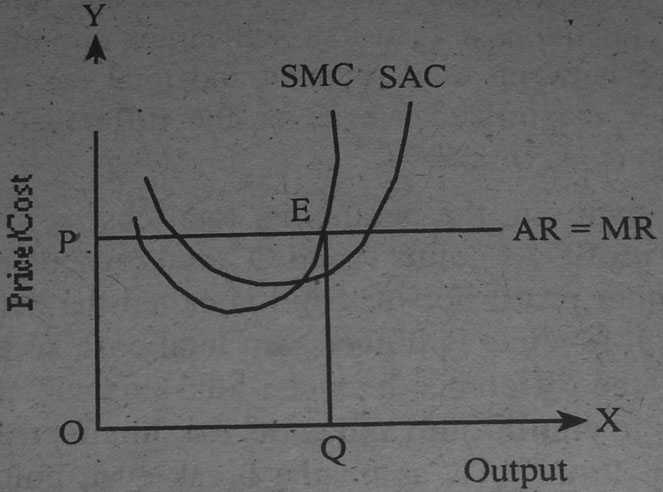
The equilibrium of a firm in the perfect competition can also be shown through the help of marginal revenue (MR) and marginal cost (MC) approach. For fulfilling the condition of maximum profit, marginal cost (MC) must be less than marginal revenue (MR). A firm is said to be in equilibrium when marginal cost (MC) must be equal to the marginal revenue (MR) or MC curve must intersect MR curve from below. It is shown in the figure:


In the figure, AR and MR are the same and AR = MR is a straight line. It is assumed that MC falls at first and then starts rising. MC curve cuts MR curve at E point from below and it is equal to MR. The profit maximizing output is OQ where firm fulfills two basic conditions of equilibrium.

ii) Equilibrium of a firm under imperfect competition (Monopoly)

Under imperfect competition, AR and MR of a firm are two different things. This is because under imperfect competition, a firm is a price-maker. It can sell more by lowering the price of its output. In the figure, AR and MR curves of a firm fall downward from left to right. According to this approach, for a firm to be equilibrium or maximization of profit, marginal revenue should be equal to marginal cost and marginal cost curve should cut the marginal revenue curve from below.
 

In this figure, at point E both the conditions of equilibrium have been fulfilled. Hence, E is the point of equilibrium. The firm gets equilibrium at OM output where marginal revenue is equal to marginal cost. The OM quality of output is sold at price OP price. Before OM output, the increase in output add more to revenue than to cost but after OM output, the increase in output adds more to cost than revenue. Profit is the total revenue OMQP minus total cost OMNR. Hence, the firm earns the abnormal profit equal to RNQP.

Criticisms/ Demerits of Profit Maximization Theory

The objective has been criticized by some economists saying there may have other objectives in a firm such as sales maximization, welfare or satisfactions etc. This objective is criticized on the following grounds.
  1. Profit maximization criterion is vague and ambiguous. Profit may be long-term, after tax or before tax. It is not clear.
  2. In this objective, total profit earned during the life of assets and timing of their realization is ignored. Hence, equal value for earning realized on different periods is not realistic. It ignores the time value of money.
  3. This objective is concerned only with the size of profit and gives no weight to the degree of uncertainty of future profits. Two businesses with varying degree of risk and producing same size of profit is considered similar under profit maximization criterion. Thus, the risk element is ignored, which is one of the most important dimensions of financial management.
  4. This objective is incomplete because it ignores the appreciation in the value of securities or firm. Investors and owners of the businessmen are benefited not only by the earning of profit, but also due to the appreciation in the stock price.

  SOME RELATED LINKS