Showing posts with label Pricing. Show all posts

Marketing is seen as the task of creating, promoting and delivering goods

Marketing is seen as the task of creating, promoting and delivering goods and services to consumers and business

Marketing is a term of common usage. In general view, it is related to buying and selling goods produced. But marketing is not only concerned with buying and selling of goods and services. It is that commercial process which attends and facilitates the movement of goods and services through the economy to enlarge and satisfy consumer need consistent with the corporation's fundamental objectives. In other words, marketing is an exchange process between producers and consumers, in which the producer matches a marketing offering (the product or service, plus its promotion, distribution, and price) to the wants and needs of the consumer.

Marketing is the business function that identifies customer's needs and wants, determines which target markets the organization can serve best, and designs appropriate products, services, and programs to serve these markets. However, marketing is much more than just an isolated business function. It is a philosophy that guides the entire organization. The goal of marketing
is to create customer satisfaction profitably by building value-laden relationships with important customers.

Definitely, marketing is seen as the task of creating, promotional and delivering goods and services to consumers and business. Following definitions help to explain it. 

According to E. Jeome McCarthy, "Marketing is the performance of activities that seek to accomplish an organization's objectives by anticipating customer or client needs and directing a flow of need-satisfying goods and services from producer to customer or client."
In the words of Stanton, Etzel and Walker, "Marketing is a total system of business activities designed to plan, price, promote and distribute want-satisfying products to target markets to achieve organizational objectives."
According to American Marketing Association, "Marketing is the process of planning and executing the conception, pricing, promotion, and distribution of ideas, goods and services to create exchanges that satisfy individual and organizational goals."
According to Philip Kotler, "Marketing is a societal process by which individuals and groups obtain what they need and want through creating, offering, and freely exchanging products and services of value with others."

The above definitions emphasize that marketing focuses on activities to satisfy customer. Marketing consists of those activities which are associated with product, price, place and promotion. Marketing is an on-going process of discovering and translating consumer needs and wants into products service through planning, producing and creating demand, serving customer and business demand through planned physical distribution system and expanding markets in the face of keen competition under certain commitments.

Now, we can say that marketing is seen as the task of creating, promotional and delivering goods and services to consumers and business because these are the core function of modern marketing. It focuses on consumer and business needs, coordinates all the activities that will influence consumers and business firms and generates profit by satisfying them.

You may also like to read:

Pricing Strategies in Marketing || Market Entry Strategy, Product Life Cycle Strategy, Price Change Strategy, Psychological Pricing Strategy ||

Pricing Strategies


Producers face several problems, challenges and difficulties at the time of pricing their products. Besides, pricing strategy should be adopted to fix reasonable and proper price. Fixed price strategy should be adopted accordingly on the basis of pricing strategy. The main strategies are as follows:

Pricing Strategies

1. Market Entry Strategy


Producers produce various products. All the old and new products should be sent to market for sale. Specially, the marketing manager may adopt two strategies for sending new products to market for selling. They are as follows:

  1. Market skimming pricing: Fixing more price of new product at the beginning is called market skimming pricing. According to such pricing strategy, price of new products becomes a little more than estimated price of target market. Even if the price of new product is more, the customers become eager to buy the new ones. Effort is made to recover research expenses in shorter time by convincing the customers that the price is reasonable with good quality. Under this strategy, company is made flexible and decreases price is needed. If the new product has good quality with good features and is safe from competition, this price may be fixed for taking benefits from the best element of the market.
  2. Market penetration pricing: Determining very low price in the course of supplying new products to markets is called market penetration pricing. According to such policy of pricing, the price of new products is fixed much lower than the expectation of the target market. The main purpose of determining such price is to take market share immediately and prevent competitors from coming to the market. If the market of the products is vast or there is intense competition, this pricing policy becomes very useful. But, if the market is limited and there is no competition, this strategy is not suitable.


Products/goods also have a life cycle like living things. Different pricing strategies should be determined according to the life cycle of the products. The given strategies to be adopted in the following situations:

  1. Introduction stage of products: Introduction stage of product is the first stage of its life. At this stage, market entrance strategy may be adopted. This strategy includes market hunting pricing and market penetration pricing from which large share of market can be occupied.
  2. Growth stage of product: At this stage of product life cycle, sale of products mounts very high. Prices of the products should be cut down a little to encourage this tendency.
  3. Maturity stage of product: Competition of the products grows at this maturity stage. Sale and profit remain stable. Although sale of products continues at beginning of this stage, the rate of growth may decline. So, in such situation a strategy should be adopted to cut down price rate slightly in order to maintain market share.
  4. Decline stage of product: Sale quantity declines very fast at this stage of product. Only some loyal customers may decide to buy the product. So, the strategy to decrease advertisement cost, cut price down and maintain existence of the firm should be adopted.

3. Price Change Strategy


The environment of any market cannot remain same forever. It changes frequently. Price also should be changed according to the change of market environment. But, while changing price, study and analysis of customers’, competitors’, suppliers’ and government’s reactions should be done. There are two alternatives in price changing strategy. a) Increase, or b) Decrease.

  1. Price increase strategy: Even a country has to face different problems. Due to inflation in the country, new taxes arrangement by government and lack of supply, prices need to be increased.
  2. Price decrease strategy: The producers should face market competition at any cost. On the other hand, full capacity of the company should also be used. Besides, the company should not escape from price war. In such situation, any company or firm should cut down the price.

4. Psychological Pricing Strategy


Determining price considering the customers’ perception is called psychological pricing strategy. This type of strategy encourages sentimental customers to buy products. This pricing strategy includes the following strategies:

  1. Odd even pricing strategy: Customers can be encouraged to buy products even by determining odd and even price. Odd price should be fixed to make the customers realize the price is low. For example, according to odd pricing strategy, price of any product can be fixed $99.95 instead of $100. Only $0.5 is different between the two prices. But customers may feel very different from each other. The customers can buy the product thinking that the price is very low. Even price fixing makes the customers realize that the product is of good quality. So, customers can also be encouraged to buy products by fixing even price. This type of price may be $150, $200, $250, $300 etc.
  2. Customary pricing strategy: This pricing strategy is based on the traditional practices. Product prices are determined on the basis of customers’ expectation. For instance, as a practice everybody has known that the price of Nepalese match is Re. 1. So, if the price of a match is fixed more or less than Re. 1, then the customers may be psychologically affected. So, the producer should also fix price Re. 1 for the new match. However, such pricing strategy may not be practical in view of cost.
  3. Prestige pricing strategy: prestige pricing strategy can also be adopted to establish prestige of any product. According to this strategy, price of the product is determined very high. This makes the customers think the product is of high quality and want to heighten their prestige by buying such products. Prestige price may be determined for ornaments, drinks, vehicles, other luxury goods etc. because the customers of such products/goods may be economically strong.
  4. Discount strategy: Discount pricing strategy also may be adopted for any product. According to this strategy, price of product goes high. Then the seller can be offered heavy discount for the product. Such pricing techniques encourage the customers.
  5. Promotional pricing strategy: Reputed companies can be offered cash rebates, longer payment terms and low price of the established product. Such pricing techniques are called promotional pricing of the product. This strategy remains for short run term because the competitors may follow it. So, the firm should improve product quality and services through advertisements.


Pricing Strategies in Nepal


Effective pricing policy can increase sales volume of product. Reasonable and correct price of product encourages sales. Such price of product helps to maintain and improve market share. It also greatly helps in facing market competition. Every producer company wishes to maintain stable price. Proper pricing strategy should be adopted for stability. Nepal’s business companies and entrepreneurs are found to have practiced following strategies:

1. Location precising strategy


Price of one kind of products may be different in different places like in Himalayan region, hilly region, Terai region, in valley etc. Although the cost for the product becomes same, the price becomes different for several reasons. Transport cost is an effective element to cause differences in price according to place. Price of Nepal Oil Corporation can be taken as an example.

2. Product mix pricing strategy


Production companies produce different goods using one transport cost. Prices of such goods are determined according to quality, features, facilities and utility. The customers should pay the price of the products which they decide to buy. Discount may be given for buying some products and may not be given for others. For example, Nepal Telecom gives discount on the basis of time.

3. Response pricing strategy


Producers may determine price on the basis of one or the other factors. The customers, consumers and competitors begin to express reactions. After the logical reactions have been received, the producers are compelled to make review. Some changes can be made in price of the products in order to face healthy competition. This increases the sale quantity. If price of the product needs to be cut down, discount facility may be closed.

You may also like to read:

Pricing Policies || Flexible Price Policy || Discount and Allowance Price Policy || Geographical Price Policy || Product Mix Price Policy ||

Pricing Policies


Different pricing problems may appear in any company. Pricing policy should be made to determine to solve pricing problems. This policy provides guidelines to marketing manager. Such policy does not change in usual situation. Main policies of pricing are mentioned in the following figure:


1. Flexible Price Policy


Any firm or company can make pricing policy in several ways. It may make policy to fix price of product or service on the basis of flexibility. Such policy includes the following two policies:

a) One price policy

One price policy is such a policy which collects same/one price from all customers. This type of price policy makes price administration easy, saves time of marketing experts, customers feel convenience etc. Apart from this, customers do not compare price and so it also becomes beneficial to the company. Firm / 
company may adopt such policy at the place where sales are done. For instance, this policy may be suitable for departmental store, super market, chain store etc.

b) Price discrimination policy

Price discrimination policy is made just opposite to the one price policy. Producers or companies charge different prices for same products in different geographical areas of the market segment that is called the price discrimination. The discrimination in pricing is made on the basis of consumers’ class or different zones. Sometimes the firm itself or the sellers sell some products to different customers at different prices. Generally, the sellers use this pricing policy for consumer products. some examples of price discrimination have been given as follows:
  1. Customer discrimination: The task of fixing different prices of the same products for different customers is called customer discrimination. Discount facilities for students in cinema hall, transport service, zoo are some of the examples of discrimination.
  2. Product version: Different prices can be changed for the same product, according to the features, utility and its services. It is called product version discrimination. This type of discrimination is made in prices of books for students and regular readers by different organizations including libraries.
  3. Different time: Different prices charged for the same service are called time discrimination. Nepal Telecom has discriminated prices for telephone calls for different times such as morning, evening, day, night etc. On Saturday price for national trunk serve has been fixed nearly 50 percent less than normal as facility.
  4. Different locations: Differentiation in pricing is made on the basis of location which is called locational discrimination. For example, ticket prices for same service such as travelling by train, tram, etc. and film halls, stadium, become different according to classes, but services are of the same nature.

2. Discount and Allowance Facilities


Some discount from listed price can be given to the customers. Cutting down price of product or services is called discount and allowance policy. Discount policies are also of different types. They are mentioned as follows:

a) Quality discount

Sales department can make policy to give discount on the basis of sale quantity. This type of discounts can motivate the customers to buy a lot of goods from the same seller. For example, $30 is charged for one unit of product, but if one dozen is bought by any customer, the same product can be charged only $29 per unit. In the same way, if one gross is bought by anybody, then $28 per unit can be charged. So, the more quantity is sold, the higher discount/allowance may be given to the customers. That means the more the sale quantity, the lower the price becomes.

b) Seasonal discount

Every product has its seasonal importance. Cutting down price of season – off products or services is called seasonal discount. Price of such product has high price in season and low in off season, for example, hotel service, plane service etc. Price at the hotel in Kathmandu decreases in off-season and increase in season. They give heavy discount due to competition. Similarly, in the months of Poush and Magh, the price of woolen sweaters, jackets etc. are sold at high rate and the price is cut down in Jesth and Asadh.

c) Cash discount

The discount in cash given for getting quick payment of price for the goods sold on credit is called cash discount. Suppose credit period is for 30 days, but if it is to collected within 10 days or the buyer wants to pay soon, cash discount is given for such sooner payment. Discounts have also their own terms and conditions. If the credit period is for 30 days and the customer wants to pay the price in 10 days, up to 2% discount may be given. The discount given in this way is cash discount. Such discount develops in customers as a trend of quick payment of credit.

d) Trade discount

The discount given to distribution channels for selling or storing is called trade discount. Trade discount helps in sale promotion. For example, per unit price of some ‘A’ product is $15, if it is sold for $14, the rest $1 is trade discount. This discount is given to wholesalers and retailers. As it is the discount to them for working as the distribution channel, this is also called operating or working discount. Cutting down listed price of goods or services for performance of nay work or giving some cash to the distribution channels is called allowance. Such allowances may be promotional allowances and trade in allowances. They are mentioned as follows:
  1. Promotional allowance: Agents, dealers and wholesalers advertise products and provide different services to customers. For providing such services, the products either cut down price of the products for them or give some amount of money as reward. Such facility provided by producers is called promotional facility.
  2. Trade in allowance: Trade in allowance is price reduction given by an organization for returning in an old product when buying a new one. Such services one most common in the car industry and other durable goods. Generally, such allowances are also provided in the situation of high competition.

3. Geographical Pricing Policy


Price of products or services can also be determined on the basis of geographical situation. Buyers or customers may live in different geographical regions. The cost for supplying the products to such regions and customers, transport costs, insurance cost, management expenses, advertising expenses etc. may be different. Price of product cannot be same in all geographical regions. So, the following policies can be adopted under geographical pricing policy.

a) F.O.B. Price

According to FOB pricing policy, producers determine factory price of their products and they transport the products up to airport or seaport for shipping at the factory price rate. After then, all the expenses for transport should be incurred by the purchasers themselves. So, as transport fare for long distance becomes high, the price of the products also becomes high. For short distance, transport fare becomes low due to which price also becomes low. In short, in Free on Board price policy, all the transport expenses should be incurred by the purchasers. Prices in different regions may be different for the same product.

b) Zone price

At first big market should be segmented on the basis of zone or area for adopting zone price policy. Then price should be determined for different zones/ areas by fixing average transport fare. As the average transport fare becomes different for each zone, the prices may also differ in different zones. But in same zone, the price becomes same. In Nepal, price of petroleum is different in different zones, but it is same in all parts of same zone.

c) Base point price

Producers may also adopt base point pricing policy. Under this policy, producers determined price rate of product by fixing a base point. Transport expenses for the transport of products from the base point to the purchaser’s place are incurred by the purchasers themselves. So, price of any product may be different at different places on the basis of the transport charge paid by the purchasers.

d) Uniform price

Policy to provide any product to the customers of all geographical regions at same price rate may also be adopted. For this, average transport fare to the markets is calculated and price is fixed same for all geographical regions. This is called uniform price. Products are supplied to the customers at any place or region at the same price rate. In our country Nepal, CocaCola and Pepsi companies have adopted uniform price policy.

e) Freight absorb price

Price of any product may be determined incurring all transport fare by the producers themselves. Price may also be determined incurring some or cent percent fare by the producers. To supply new products to target market or face intense competition, this type of transport fare attraction policy is adopted. This policy may attract the attention of the customers.

4. Product Mix Price Policy


Every firm may produce different types of goods. Prices of all goods may not be the same. Price rate of different products should be fixed differently according to the quality and features of the products. Product mix policy includes the policies as follows:

a) Captive product price

One task may be completed using some two products. In other words, one product needs for using other product. Such products are called captive products. In captive products one may be main and the other auxiliary product. For example, camera and film are captive products. Only camera can do nothing or only film can do anything. Camera may be taken as main product and film as auxiliary. So, a policy may be adopted to fix the price of main product more than the price of auxiliary product.

b) Product line price

Producer may adopt product line pricing policy. There may be different products of different quality, features, colors, design etc. under one product line. Different price should be fixed for different products. This makes customers feel easy to discriminate products. They can get opportunity to select products comparing price and quality of the products.

c) Optional feature price

Policy may be adopted to determine price of any product by adding or taking off some features to or from any product. The price of computer may be determined on the basis of features. It may be sold by adding all the different features and facilities or only with some features. Addition of different facilities and features to computer increases price. However, customers become ready to pay more amount of price for the added facilities and features. If they do not like to have various facilities and features, the computers may be sold at low rate. It depends on the desire of the customers.

d) Two parts price

Under this policy, prices of products or services can be fixed at two stages: they are as fixed and variable costs. In other word, one price rate for products or services is paid up to a certain limit, and other price rate is paid if the products or services go beyond the limit. For example, the price for the services of Nepal Telecom can be cited as an example. Nepal Telecom has fixed certain amount of price for certain calls (one rate for up to 175 calls) and if the fixed calls cross the limit, different rate is charged for the extra calls. Similarly, Nepal Electricity Authority has fixed one rate for certain units and if the fixed limit is crossed, other price rate is charged for the extra units.

e) Product bundle price

Fixing price for a mixed bundle of different products is called product bundle price. Combined price may also be fixed for a bundle of different products mixed together. With such policy different products can be sold together. Make up set, cosmetics set, suit set, ornament set, cup and plate set, tea set etc. are the examples of product bundle price.

You may also like to read:

Initiating and Responding to Price Change || Maintaining Price || Increasing Price and Quality || Reducing Price ||

Initiating to Price Change


After goods have been produce, price is determined on the basis of its cost and taking reasonable profit. The price so determined may also need changes. Due to external and internal environmental effects, prices may need changes. Two main strategies can be adopted in leadership pricing as follows:

1. Initiating price cut


Every business firm wishes to increase its sale quantity. Changes in price may be needed to achieve such objective. So, the producer should cut down necessary amount of leadership price of the products. Sometimes companies’ products can enter in more markets segments only after cutting down prices. This strategy should be adopted in order to face strong competition. Otherwise, there may appear a situation either to quit the market segment or abandon the production. On the other side, there may be a compulsion to cut down prices of products to control the target market segments.

2. Initiating price increase


Sometimes a strategy to increase in price may be adopted not affecting sale quantity. Price may need some changes due to cost inflation. Price may need changes due to government’s policy to control price or to increase revenue. On the other hand, demand for products may grow suddenly. In such situation, one needs price change. In the situation when all continuations are suitable, price may be increased according to the time. However, such increase should be very low in percent. Price should not be increased at the rate which may spoil the image and competition of the company.


Responding to Price Change


While changing price of any products, many reactions may come from concerned sides. At first reaction may come from consumers. Such reactions may be positive when price is cut down and negative when it is increased. The company should carefully as well as logically answer both reactions. In the same way, competitors’ reactions may also come. The company should give satisfactory answer to them with all reasons such as cost, market study, transport expenses, administrative expenses, etc. The following strategies should be adopted to face reactions of competitors and distributors.

1. Maintaining Price


The producers should try their best to maintain price at the same rate. Producers may cut down some percent of profit. The existing market segments can be maintained with such strategy. Along with this, opportunity can be found to enter new market segments. In this way, sale quantity may increase.

2. Increasing price and quality


Producer may increase in existing quality and price. Production companies may bring in markets the new products or adding new features to the products challenging their competitors. Little more prices of such products do affect competitors so much. However, such analysis cannot last long. Other competitors also may adopt such strategy. This may be only a periodical means to stop competitors’ reactions. After sometime, the company should seek other alternatives.

3. Reducing price


Most of the customers become conscious about price. So, the producer should cut down the price of the products after certain time. Competitors of similar products also may adopt this strategy. The producers who cannot adopt such policy may get compelled to quit main market segments among many segments. Such markets once quitted need very hard labor to supply products to there again. Policy of taking low percent of profit should be adopted. Even decreasing price, quality, features and services should be maintained same. Only then, products can control markets.

Methods of Price Determination || Cost Oriented Pricing || Demand Oriented Pricing || Competition Oriented Pricing ||

Methods of Price Determination

Price determination is very difficult and challenging task. So, reasonable price should be determined only after identifying the factors affecting it and objectives. According to traditional practice, price can be determined through interaction between seller and buyer. But in the modern marketing, many methods of price determination have developed. The main methods are follows:

1. Cost-oriented pricing


This cost oriented method gives special care to cost of products. The cost oriented pricing method is also divided in three classes:

a) Cost – plus pricing

This cost – plus pricing method is also called mark-up pricing. This pricing method is very simple and popular. According to this method, price of any product is determined by adding certain percent of profit. Mostly small producers and retailers use this method. Besides, construction company, legal advisors, accounting experts and other professionals determine price of products or services using this method. According to this method, special qualification or experience is not needed to fix price. So, this method can be used by any person. One imaginary example can be presented for making it clearer.

If a pair of football shoes costs the seller Rs. 100, and the seller wants a mark-up of 25 percent, the price will be set as following:

Cost-plus price = Cost + (Cost x desired mark up)

Selling price = Cost + (Cost x desired mark up)

 = 100 + (100 x 25% = 100 + 25 Cost-plus price = Rs. 125

 For making clear the cost - plus price of any goods or services, easier method can also be applied. Suppose, an umbrella has cost Rs. 200/-, if the producer wants to sell it taking 25% profit, the price of the umbrella can be determined in the following method,

 Cost-plus price = Unit cost + Profit margin = 200 + (25 x 2) = 200 + 50

 Cost-plus price = Rs. 250

b) Target return pricing

Every investor invests his capital to get return. The income expected from such investment is called target result. According to target result pricing method, expected result is added to total cost and is divided by sales units. Break-even analysis can also be used for this. Such pricing policy is applied by market monopoly companies or the people’s utility organizations with mass production. Target result pricing method can be understood from the following example:

Suppose, a pocket calculator manufacturer has the following information. Determine the price of calculator on the basis of target return.

Pricing Method: Total investment = $900,000

 Target return on investment = 20%

 Total cost = $500,000

 Unit Sales = $10,000

 ROI = 20/100 x 900,000 = $180,000

 Per unit price = Total Cost + Target ROI/Unit Sales

 = 500,000 + 180,000/10,000

 = 680,000/10,000

 = $68 Price

 = $68

 The unit price would be set $68.

c. Break-even pricing

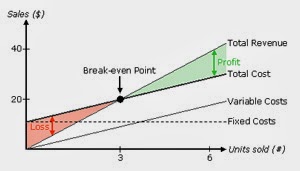
The situation when income and total costs become equal is called breakeven pricing. This is another important method used to determine price of products or services. In this analysis, relation between cost, quantity and profit is studied. In this breakeven situation, the firm neither earns profits nor suffers loss. If goods are produced in large quantity from breakeven point, the firm can earn more profit, but gets loss from breakeven point, the firm can earn more profit, but gets loss from the production if less quantity is produced from this point. For analyzing breakeven point, cost can be divided into two classes as (a) fixed and (b) variable. Variable cost changes with production.

If production quantity is increased, variable cost increases, and if decreased, it also decreases. Direct materials, wages and other expenses are variable costs. Fixed cost remains same even if production increases or decreases to certain limit. This means it does not increase or decrease with production quantity. Rent, interest, salary etc. are fixed costs. It is believed that while calculating breakeven point, total fixed cost and variable cost remain same per unit. To make the method of determining breakeven price clear, the following example is presented:

Suppose a manuafacturer had the following information about a pair of shoes:

 Fixed costs = $32,000

 Selling prie per unit = $22

 Variable cost per unit = $12

 Breakeven point = ?

 Breakeven point can be calculated using the following formula:

 Breakeven point (Units) = Fixed cost/Price - Variable cost = 32,000/22 - 12 = 3200 units

 Breakeven point (Dollar) = Fixed cost/1 - Variable cost per unit/Selling Price per unit

 = 32000/1 - 12/22 = 70,400

 BEP ($) = 70,400

Break Even Chart

 where,

 BEP = Break Even Point

In the above given figure, total revenue and total cost are crossed by each other. Breakeven point is located at the cross-point. At this point, the total income can recover total cost. So, at this point of production, firm can neither earn profit nor incur loss. If the firm produces more than breakeven point, it can earn profit, otherwise it incurs losses. If the sale price is increased, BEP (Breakeven point) and market demand also decrease. This method helps to recover production cost through selling at certain price. However, fixed cost does not remain always fixed and cost cannot be classified in fixed and variable. So, it does not become useful in practice.


2. Demand oriented pricing


Demand oriented pricing method is also called profitable pricing. This method gives emphasis only on customers’ value, perception rather than to the cost of production or services and market fees. Under demand oriented pricing, the following methods can be included:

a) Perceived value pricing

This method has become very popular in determining consumer goods. According to this method, business firm collects information about consumers’ views, perception, experiences, feelings etc. Then price is determined by calculating average on the basis of such information. In this method of pricing, the cost of production is not taken as an important element/factor. The price determiner of the cost oriented products, at first determines production cost or services. But in this method, at first, customers’ perceptions are collected and average is made out from them.

b) Customer value pricing

According to the customer value pricing method, business company fixes very low price for high quality products. The company does so in order to occupy/control market share. Sometimes the market price becomes lower than cost price. This method of pricing is used by the companies having several product lines or products. Even such companies may apply this method only to some products but not to all products. They sell other products or services at premium prices. Their main purpose of doing so is to attract customers’ attention towards some products through customers’ pricing or value pricing. Such companies make a strategy to sell their other products in maximum quantity at premium price.


3. Competition Oriented Pricing


The method of determining prices of products or services by giving priority to market competition is called competition oriented pricing. This method does not care demand and production cost. In this method, price may be fixed at going on rate, more or less than market price. Under market oriented or competition oriented pricing the following methods can be used:

a) Going rate pricing

If price of products or services is determined on the basis of market price, it is called going rate. In this method, price is determined on the basis of competitors’ price (equal to the price of the products of the competing companies). This method is mostly used in fully competitive market or in same products. Generally, this method is used in steel, paper and fertilizer, agricultural and mineral products. Small companies fix price only after the big companies fix prices of their products. The companies which fix prices with this method may have their objective to face market competition.

b) Pricing below competition

The method of fixing prices lower than the competitors’ price is called pricing below competition. This method aims to attract price sensitive customers by sweeping market competitors aside. In this method, price of every product is fixed lower than the competitors’ price. This method of pricing may be very dangerous/risky, because the customers may think substitute products or service of lower quality for its lower price/rate. At such time, the related company may suffer losses.

c) Pricing above competition

According to this method, price of products or services are fixed higher than the prices fixed by competitors. Generally, such pricing method may be applied for quality products or reputed brands. This method of pricing may also be used to show to the customers that the product is of higher quality and more useful than those of competitors. This method also tries to popularize the products among customers by impressing them that the products have added quality, specialty and utility.

d) Sealed bid pricing

Sealed bid pricing is also based on competition. In this method, price is determined on the basis of estimates of the price the competitors may offer. So, in this method, production cost is not considered. Price should be fixed lower than the price offered by the bidders to get success in sealed bid. If the price becomes higher than the competitors’ price, such sealed bid may be rejected. So, the price should be fixed lower in competition than the price of the competing bidders who have registered sealed bid. Only such type of sealed bid becomes acceptable.

Some offices call sealed bids as they need to perform their works following rules and regulations. If any government office has called for sealed bid, sealed bid should be submitted giving every detail of the goods and prices. For submitting sealed bid to any office, price of products or services should be fixed. Therefore, according to this method, price should be estimated less than the price offered by competitors, but such estimate should be rational / reasonable. In government and semi-government offices in our country, if any goods or services of more than prescribed amount are to be purchased, this method is compulsorily used.

You may also like to read:


Factors Affecting Price Determination || Internal Factors and External Factors ||

Determining price is very challenging task. Analysis of various factors should be done to determine price. In other word, various factors affect price determination. So, they should be specially considered. Two types of factors should be studied before determining price. They are internal and external factors.

I. Internal Factors


The factors which can be kept under control of business organization are called internal factors. Such factors affect price determination of the products. Internal factors include,

1. Business efficiency

Internal factors are of different types. Among them business efficiency is one of them. It directly affects price of products. If the business firm is capable, cost becomes less and purchases of raw materials and other activities are effectively conducted. As a result, price of product can be determined low. Just opposite to it, if organization is incapable, production cost becomes high. As a result, the price needs to be determined high. As business competency can be increased, firm can keep it under its control.

2. Organizational factors

Different organizations have their own organizational factors. Under such factors, production policy, pricing policy and prestige of the company are included. These important factors affect pricing directly. Such policies are formed by the top level management of the company. So, these types of organizational factors can be kept under the control of organization. Price can be determined by improving such organizational factors in opportune time.

3. Cost

Without production cost, no goods can be produced. As price of product needs to be determined including production cost, then price also increases due to increase in production cost. Just the same, if production cost decreases price decreases. Mostly, the following costs are included in producing any goods.
    • Factory expense: This type of expense is also called factory related indirect expense. This includes transport expenses, labor wages, fuel, water, factory rent, electricity, consumer goods, and factory repair and maintenance etc. expenses.
    • Direct expense: This expense includes salary, office, direct wages, and other direct expenses.
    • Administrative expense: This includes salary, office rent, telephone tariff, electricity, postage, telegram, director’s remuneration, office repair and maintenance, office equipment and other expenses.
    • Selling and distribution expenses: This includes sellers’ salary, commission to distributors, external transport and transport expenses, advertisement, warehouse rent, packing fees, and other expenses. Such expenses are called direct expenses on selling and distribution. Production cost can be lowered by increasing administrative ability and efficiency. So, this factor is also a controllable factor.

4. Pricing objective

Before determining price of any product, its objective should be taken. So, this is other important factor to affect pricing. These pricing objectives include achievement of targeted result, maximization of price, increase in sale, increase in market share, maintenance of price stability etc. Besides, objectives for facing competition and survival of the organization should be also clearly made. The objective of firm affects the price of products. If the objective is to maximize profit, price should be fixed high. But, if the objective is to expand / increase market share, price should be fixed low. The objective of price fixation is also controllable factor of firm, which can be changed or improved according to need.

5. Other elements of marketing mix

Different elements / factors of marketing mix affect the pricing objectives. The other elements such as product, place, promotion also give pressure to decrease or increase price. They can be mentioned as follows:
  • Product: If the product is original, pricing becomes easy. But, if it is imitated, comparative price should be fixed. In this way, price of different products can be fixed differently. Little difference in price happens at every stage of life cycle of any product.
  • Place: Distribution channel also affects price. If the distribution channel is long, more cost needs for it. As a result, price increase. Similarly, means of transport also affect the price by increasing cost of any product. In comparison to air transport, cost for road transport becomes less expensive and dependable.
  • Promotion: Promotional style and activities also affect price of products. newspapers, radio, television, etc. become expensive for advertisement and increase the cost of the products. But, if distributors, agents, wholesalers and retailers take the responsibility for advertisement, it becomes less costly. So, different promotional activities also affect price of products.

II. External Factors


Any factors which are beyond the control of a firm are called external factors. Such factors may be very strong and influencing. There are different kinds of external factors. They are as follows:
  1. Competition: Competition is one of the effective factors to affect pricing. Competition plays an important role in price determination. If there is no competition price, it can be fixed freely. But, if there is market competition, competitors’ products should be analyzed and suitable price should be fixed. If the products are similar in quality, price also should be fixed same. So, competitive price should be fixed for the products. Before fixing price of any product, deep study should be done on competition. Competition also may be of various types. They directly affect the price of products. Since competition is the factor not to remain under firm’s control, study and analysis should be done on it. Only then the price of products should be fixed.
  2. Suppliers: The group, or firm or organization which provides necessary equipment, raw materials, machines, operating means, etc. is called supplier. If they provide such industrial goods at easy price, price of products also becomes low. But just the opposite of it, if such industrial goods are costly, the price of products also becomes high. So, suppliers also have an important role in pricing any products. This is the second external factor. It cannot be controlled by any business firm.
  3. Pressure group: In every country, pressure groups may be formed in different ways. Save environment group and consumer group are the examples of pressure group. Such groups try to affect price of products. They give pressure to companies/business firms for their own group interest and welfare. Save the environment group can give pressure to business companies for stopping pollution. Consumer group can give pressure demanding for providing high quality products at lower rate, for more security of products, and for providing more information about products. Such pressure directly affects price. These types of pressure remain beyond the control of the company.
  4. Economic factors: Economic factor/element is one of the strong factors to affect price determination. This also affects price. This element does not remain under company’s control. Situation of inflation, deflation, overvaluation or devaluation may appear in markets. They are called, on the whole, economic elements/factors. In the situation of devaluation demand decreases, whereas in the situation of overvaluation demand increase. So, price should be determined only after studying and analyzing the economic factors/elements. If production cost increases, price should be fixed accordingly, and if production cost is low, price should be fixed low increasing rate of profit. In this way, when cost is decreased or increased, price also should be fixed accordingly. Policy to increase price in the situation of deflation and decrease in the situation of overvaluation should adopted.
  5. Market demand: Demand of target market also should be considered and studied by every business company. The total demand of the market also affects pricing. Demand for products may decrease or increase due to the reasons of total number of customers, their income, purchasing power, priority, competition among substitute products etc. A situation may appear to determine price on the basis of demand. In the situation when the total demand for products has declined, price should be decreased and when demand is increased it should be increased. If such policy cannot be adopted, price of products does not become reasonable.
  6. Government: Government makes arrangement of different policies, rules and regulations giving priority to the interest of the nation and people’s welfare. Such policies, rules and regulations also affect price determination. Government may try to keep business companies under control by interfering in price fixing and making policies and provision to provide facilities to the people. Government may make policy to provided facilities by rebating sales tax, excise duty, costume duty, etc. and just the opposite it may charge all of them to increase revenue. In this way, government policies and rules also directly affect pricing determination. If government makes policies to charge new add taxes or increases in taxes, then the business companies also increase price. If taxes are rebated, price is decreased, and if they are increased or added, price increases. So, government policy also directly affects pricing. So, government policies, rules, regulations, legal provisions etc. also are the uncontrollable external factors to affect price determination strongly.
  7. Political situation: Different political modes or situation may prevail in every country. Political situation also affects price determination. Political situation may be stable or instable according to the time. In both political situations, price of products or services may not remain same. If the political situation is stable, one rate or price is fixed, and if it is unstable, another rate is fixed. Government may or may not interfere in pricing. Method of determining prices differs between the interference and free situation. In some countries, there may be legal provision to fix prices of products by government. So, business competitors should compulsorily face such situation.
  8. Market intermediaries: In every market, different intermediaries remain active. They can be identified/ known as agents, distributors, intermediaries, transporters, finance companies, wholesalers, suppliers etc. If such intermediaries change their prices, prices of products or services also should be changed. In other word, if prices of such intermediaries increase or decrease, price of products or services should also be increased or decreased. No company can control their activities but are compelled to fix prices according to the main-stream of the intermediaries.

You may also like to read:

Pricing: Meaning, Objectives and Importance of Pricing

Meaning of Pricing


Generally, the amount to be paid for any goods or service is called price. Price is one of the important factors of marketing mix. This is also the main source of income of any business organization. So, profit or loss of business organization depends on the price of products. Price also expresses the quality of products/goods. Generally, high quality goods have high price and low quality goods have low price. Customers select goods on the basis of the price according to their buying capacity. Without certain price no exchanges of any goods or services can be done. So, price has important role in marketing. Generally, price is measured in currency.

In the developing or underdeveloped countries like ours where economic condition is very weak, goods or services are also measured in other form. Price of any goods taken or given according to the product exchange system is not fixed. In other words, in such system price of goods is not determined in currency.
Price means the rate paid by customers for any goods or service. For example, if a customer buys Batika Shampoo for Rs. 140, the price of shampoo is Rs. 140. Here, the utility of the shampoo and its price should be equal. Otherwise, one side gets loss. So, value/utility and price should remain in balance.

Price is the strong equipment of marketing. It simplifies exchange function of marketing. There are many names of such price. For example, interest paid for the use of currency, rent paid for the use of capital or capital assets, commission paid for use of service, tuition fees paid for the education, salary paid to employees for using their service, tax paid for earning income, premium paid for insurance, etc. 

Different writers and experts have defined ‘price’. Some important ones are as follows:

According to Prof. William J. Stanton, “Price is the amount of money and/or other items with utility needed to acquire a product.


According to Prof. Philip Kotler, “Price is the only element in the marketing mix that produces revenue, the other elements produce cost.”


According to David J. Schwartz, “Price is the exchanged value of the product or service expressed in terms of money.”


The above mentioned definitions make it clear that the amount to be paid for any products / goods is called price. The producer should take rational decision to determine such price. Generally, price is expressed in money / currency. Customers study the goods / products, select it and buy it. So, price has an important role in marketing. Price is expressed in salary, interest, tuition fees, rent, commission, premium, fee, revenue, bill, royalty, etc. This is made clearer by the following table.

A List of Names of Price

S. No. Price Product and Services
1. Salary Service of an executive, manager and staffs.
2. Interest Use of money
3. Tuition Education
4. Wage Service of workers and labor
5. Fair Taxi and airline flight
6. Commission Service of seller and distributors
7. Premium Insurance (Various insurances)
8. Fee Service of the doctor and lawyer
9. Dues Membership in a union or a social club
10. Revenue Tax and custom of government
11. Rent Use of living quarters or piece of
equipment for a period of time
12. Bill Telephone, water and electricity

The task of determining price of any product or service is called price. Determining price of any product is very challenging. So, in determining price of any product, special consideration should be taken to production cost, competitors’ prices, prices of substitute products and market environment. Besides this, internal and external obstructions also should be identified. After the obstructions have been identified, ways for facing such obstructions should be found out. Only then proper method of pricing should be applied. The price determined in such way becomes long lasting and reasonable.


Objectives of Pricing


The task of fixing reasonable value of any product or services is called pricing. To fulfill this task all the costs and profits should be included. Various expenses are included under production cost. They may be direct and indirect expenses. Before determining price of any product or services, all the objectives which are directly influenced by the organizational goal should be made clear. If the organizational goal is clear, it becomes easy to prepare the objectives of pricing. Main objectives of pricing are as follows:

Objectives of Pricing


1. Profit oriented objective


All the business organizations or companies are conducted with the main objective of earning profit. Their profit making objective may be for long term or short term. Under such task, companies or organizations form two types of objectives as follows:
  • To achieve a target result: The certain rate of profit intended by an organization or company to earn during certain period is called target result. Business firms or companies fix prices of their products with the objective to get certain result from sale or investment, for instance, 8% profit from sale, 7% profit from investment, etc. Most of the wholesalers and retailers estimate targeted result with the objective of earning short term profit. The firms or companies who do not need to face strangling competition take decision to fix such price.
  • To maximize profit: There are various types of profit making objectives. Among them profit maximization is the second important objective. Fixing maximum rate of price of any product or service to earn maximum profit in very short term adversely affects the customers. So, a strategy should be adopted to earn maximum profit in long term. Sales volumes should be maximized with the minimization profit margin for earnings maximum profit. As a result, profit amount increases. This becomes beneficial to the company/firm and society in the long run.


2. Sales oriented objective


A company may adopt a policy to increase sales volume by fixing lower rate of price of products or services. In fact, sales oriented objectives aims to increase sales quantity and market share. This objective can be studied by dividing into two classes as follows:
  • To increase sales volume: Increasing sales quantity of any product also may be one of the objectives of pricing. The emphasizes to increase certain percent of sales quantity can be increased getting permission from sales department or adopting other pricing strategies. Such strategy discourages possible competitions. Besides this, profit can increase in the long run due to minimum production cost.
  • To increase market share: Every company or firm wishes to promote sale of its products. The objective of pricing may be to increase sales quantity. This also increases market share. In this age of competitive environment of market, it is also necessary to increase market share. Some companies adopt a policy to expand market share gradually; some others adopt the policy to expand market share immediately and control it. In order to expand market share, price of products or services should be low in comparison of competitors. Japanese auto products have become very high in price in American market due to which Toyota, Nissan, Honda Companies have cut down production cost fixing low margin profit and adopted a policy to increase share in American markets. This makes it clear that market share can be increased fixing low profit margin.


3. Status-quo oriented objective


Status-quo objective is formed to maintain the present situation for long time. In this objective, price of products remains same for long. Firm or company does not take any step to change the price. This status-quo includes the objectives like continuation of same price, facing competition and continuation of existence. They can be mentioned as follows:
  • Stability in price: Price stability is one of the importance objectives. This remains effortful to maintain price at the same rate for time. Price leadership companies, frequent demand changing companies and the companies wishing to maintain reputation try not to let price fluctuate. All such companies make their objective to maintain price same at the same level. Such organizations or companies also wish to maintain revenues, price of their products, profits etc. at the same level. They do not want to take risk. They try to maintain same price by increasing production and supply in prosperity period and decreasing production and supply in depression period.
  • To meet competition: This is the age of market competition. Every business company needs to face competition for survival/existence. Companies/firms have to fix price of their products or services as fixed in the markets. So, price is fixed with a view to facing/meeting competition in market. The price leadership companies should fix/determine price of their products by studying and considering market prices. Otherwise, the prices of their products cannot face/meet competition in market; as a result they are compelled to flee away from the market.
  • Survival: It becomes very difficult to save the company/firm from high competition in market. In such situation, the firm should fix prices of their products in a way that only production cost can be recovered. In such situation, production cost may be equal to revenue. (Production cost = Revenue). This situation is called breakeven point. In this situation, there is neither profit nor loss. In this way, company’s existence is saved and it expects improvement in future. Business companies make such objectives waiting for bright future.


Importance of Pricing


Reasonable pricing plays an important role in achieving business goal. Price remains as crucial matter for business companies. Its importance is linked with various aspects. The importance of pricing is related mainly to economy, organization and customers. They can be mentioned as follows:

1. Importance to the economy


In fact, price is the important element of economy. It directly affects demand and saving. It also controls means of production. To make it clearer, a short description has been made as follows:
  • Determinant of demand and supply: As the price of products directly affects demand, price plays an important role in determining the quantity of demand. So, price has been accepted as basic element. If the price is increased but the quality of the product is unchanged, and then demands of the products decreases, and if the price is decreased, demand for the products increases. In other words, when price decreases, demand increases, and when price increases, demand decreases, hence the law of demand applies. In this way, the quantity of demand and supply depends on price; price can be identified as determinant of demand and supplies.
  • Effect to the factors of production: Price of products is very important to economy and industry. It directly affects wages, rent, interest and profits. Capital, labor, land and venture are the factors/means of venture productions. Wage for labor, rent for land, interest for capital, reasonable profits for venture should be distributed. The factors/means of production (wages, rent, capital and venture) affect demand and supply. Rate of wage attracts labor whereas high interest rate attracts capital. Hence, price strongly affects factors/means of productions.
  • Effect to the saving and investment: Determined/fixed price for target market may affect inflation. This indicates that inflation causes increase in price of products. If the price of products or service increases, the customers get in difficulties. When the price of products or services increases, consumers’ saving decreases, due to which investment is discouraged. But, if price decreases and saving increases, investment also increases. This situation contributes to the development of society and nation.


2. Importance to organization


Price of product or services is an important element/factor of marketing mix. Price management is very difficult task for profit making organizations. So, rational decision should be taken for price management. Success in market competition can be achieved; income and profits can be earned only through price. The following points are discussed to make the importance of price clearer.
  • Revenue and profit: Price plays an important role in determining income and profit of an organization. Total income can be made out/found out by multiplying per unit price by sold quantity. When sale quantity remains same, but price is decreased, income also decreases. If price is increased and sale quantity remains same, income is increased. Profit can be made out/found out also by subtracting total cost from total revenue. So, profit can be increased or decreased by increasing or decreasing price of products. But policy of frequent change in prices and profit/revenue is detrimental to the company.
  • Competition: Business organization should face various competitions appeared in market. It has to face price competition certainly. If market competition increases in the price already fixed, the organization can attract increased number of customers by decreasing the price. This increases sales volume and decreases production cost.
  • Expansion of the product line: Price directly affects organization to expand target markets and add product line. Price also helps in taking decision whether to add new product line or expand new product or not. This can be decided by comparing production cost with the price. If profit seems sure, decision for expansion should be taken. But, just opposite to it, if there is no possibility of profit but only loss, then decision should be taken not to expand the products.


3. Importance to the customers


Determination of price should be based on genuine reasons. If price has been determined rationally, this helps general customers. Following points can be discussed to make clearer the importance for general customers:
  • Importance of the product selection: Most of the customers give priority to price and analyze it. They try to select products considering their prices. Such customers minimize quality and utility. They can take decision to buy the products which contain relatively low prices.
  • Importance of the quality perception: Price plays an important role to meet customers’ necessity/want. Similarly, it is also equally helpful to assure them of the quality of the products. If high price products or services make the customers realize high quality and low price product signifies low quality.
  • Importance of customers’ benefits: Price of products affects customers’ benefits. The customers by low priced products/goods even when the income sources have fallen down. In the situation when income has increased, demand for products does not decrease even if the price is high. The customers who are sensitive to price may take decision to buy products when the price has decreased or discount is provided. Some customers give priority to their social dignity, respect and satisfaction.

You may also like to read: